

A foreign investor can identify an exceptional U.S. residential opportunity and still lose strategic control through an ordinary legal error: acquiring title in the wrong entity, overlooking withholding at exit, or accepting governance language that does not match the capital structure. The legal framework for foreign real estate investors is therefore not a closing checklist. It is the operating architecture that determines how capital enters the United States, how it is protected, taxed, monitored, and ultimately repatriated.
For institutional LPs, family offices, and international investors allocating meaningful capital, the question is not simply whether U.S. real estate is accessible. It is whether the investment vehicle preserves visibility, aligns authority with risk, and remains defensible under U.S. regulatory, tax, and reporting standards.
Contents
The Legal Framework for Foreign Real Estate Investors Starts Before Acquisition
The United States generally permits foreign persons to acquire and own real estate. There is no single federal prohibition on foreign ownership of residential property. That access, however, should not be confused with simplicity.
Ownership restrictions, disclosure obligations, tax exposure, and financing requirements can differ materially by jurisdiction, asset type, investor nationality, and transaction structure. Florida deserves particular attention because state-level rules affecting certain foreign principals, property categories, and locations may change through legislation or litigation. A disciplined process requires current legal review before a letter of intent is signed, not after closing documents are circulating.
At the federal level, certain transactions can also raise national-security questions. The Committee on Foreign Investment in the United States may have jurisdiction where real estate is located near sensitive military installations or other covered facilities. Most prime residential transactions will not require a filing, but a serious sponsor screens the issue rather than assuming it is irrelevant.
The central principle is straightforward: title ownership, tax residency, immigration status, beneficial ownership, and regulatory classification are separate legal questions. Treating them as one is where avoidable risk begins.
Entity Design Is a Capital-Protection Decision
Foreign capital should not enter a U.S. transaction by default. The optimal ownership vehicle depends on the investor’s country of residence, treaty position, intended holding period, financing profile, estate-planning objectives, and whether the investment is direct or made through a managed fund.
A single-member LLC, a multi-member LLC, a limited partnership, a domestic corporation, and an offshore holding company can each be appropriate in specific circumstances. None is universally superior.
An LLC can provide contractual flexibility and liability segregation, but it does not automatically create tax efficiency for a foreign owner. A foreign-owned disregarded U.S. LLC may trigger federal information reporting, including Form 5472 and a pro forma corporate return. A partnership structure can provide flow-through treatment, yet it can also create effectively connected income, withholding, and filing obligations for foreign partners.
A corporation may simplify certain investor-facing mechanics and potentially address particular estate-planning concerns, but it introduces its own tax layer and must be evaluated against the intended exit. Offshore ownership may offer planning advantages for some investors, yet it should never be treated as a substitute for U.S. tax analysis, beneficial ownership transparency, or institutional governance.
The more sophisticated question is not, “Which entity pays the least tax?” It is, “Which architecture preserves the intended economics after tax, supports control rights, withstands scrutiny, and remains practical at disposition?” Those outcomes are rarely achieved through a template entity formation package.
Direct Ownership and Fund Ownership Are Different Legal Profiles
Direct ownership places the foreign investor close to the asset and often closer to operational, tax, and liability exposure. It may suit investors seeking concentrated control over a specific acquisition.
Fund ownership creates a different relationship. The investor holds an interest in a vehicle rather than direct title to each property. This structure can centralize sourcing, underwriting, asset management, reporting, and disposition authority under the general partner or manager. In exchange, the investor must evaluate the governing documents with the same discipline applied to the underlying real estate.
For a private real estate fund, the limited partnership agreement, operating agreement, subscription documents, private placement memorandum, side letters, and tax disclosures are not administrative papers. They define the hierarchy of capital.

ARCSA Capital Structures Access for Foreign Real Estate Investors
Qualified international investors can review our blocker and parallel-fund options, subscription process and reporting package.
Request InformationSecurities Compliance Is Part of the Investment Structure
When capital is pooled and managed by another party, the offering may involve securities laws even when the underlying assets are residential properties. A sophisticated sponsor must address the exemption used for the offering, investor eligibility, disclosure standards, transfer restrictions, and the status of the investment vehicle under the Investment Company Act.
Many private offerings rely on Regulation D exemptions, including Rule 506(b) or Rule 506(c). The distinction matters. Rule 506(c), for example, permits general solicitation but requires reasonable verification that every purchaser is accredited. Rule 506(b) has different solicitation limitations and investor participation rules.
For fund structures, exemptions such as Section 3(c)(1) or Section 3(c)(7) are frequently relevant. The latter is particularly significant where the investor base includes qualified purchasers and institutional capital. The correct exemption depends on the vehicle’s design and investor composition, not its marketing preference.
International investors should also understand that a U.S. offering exemption does not eliminate legal obligations in their home jurisdiction. Local private-placement rules, marketing restrictions, currency controls, and investor-suitability standards may apply before capital is accepted.
A parallel offshore fund, including a Cayman vehicle where appropriate, can support non-U.S. investor participation and streamline certain cross-border considerations. Its value lies in precise coordination with the U.S. master or parallel structure, not in opacity. The strongest architecture is one in which legal, tax, banking, and reporting obligations are clearly documented across every entity in the chain.
Tax Exposure Is Determined at Entry, During Operations, and at Exit
Foreign investors should model U.S. tax consequences before capital is committed. The tax profile of a value-add strategy with accelerated exits may differ meaningfully from a long-duration rental strategy.
Income connected to a U.S. trade or business can be taxed on a net basis, with corresponding filing obligations. Passive income may be subject to a different withholding regime. Where a partnership earns effectively connected income, the partnership may be required to withhold under Section 1446 on amounts allocable to foreign partners.
Disposition requires equal attention. Under the Foreign Investment in Real Property Tax Act, commonly known as FIRPTA, a buyer generally must withhold 15% of the gross amount realized when a foreign person sells a U.S. real property interest, subject to exceptions and withholding certificates. FIRPTA withholding is not always the final tax liability, but it can materially affect liquidity if it has not been anticipated in the exit model.
Estate and gift tax planning also deserves separate counsel. A non-U.S. citizen who is not domiciled in the United States can face a markedly different U.S. estate-tax regime than a U.S. citizen or resident. Direct ownership of U.S. real estate may create exposure that is not apparent from an income-tax analysis alone. Treaty provisions, family governance, entity ownership, and succession planning can all affect the outcome.
Governance Must Match the Risk Being Taken
Legal structure is only useful when decision rights are explicit. In a professionally managed private real estate vehicle, foreign investors should understand who controls acquisitions, leverage, reserve policy, dispositions, related-party transactions, valuation methods, and conflicts of interest.
The governing documents should establish the manager’s authority while reserving appropriate protections for investors. These can include investment restrictions, concentration limits, leverage parameters, key-person provisions, removal mechanics, advisory committee rights, conflict protocols, and reporting standards.
For international capital, information rights are particularly consequential. Monthly or quarterly reporting should distinguish realized from unrealized performance, identify material project deviations, disclose leverage and liquidity, and provide a clear audit trail from capital call to asset-level execution. Sophisticated investors do not require operational theater. They require reliable evidence.
In a disciplined value-add strategy, governance must also address the period between acquisition and sale. Construction authority, insurance requirements, contractor controls, title coverage, permitting, reserve releases, and disposition approval thresholds should be managed as part of a single operating system.
Compliance Is Continuous, Not a Closing Event
Foreign ownership frequently introduces additional compliance layers: anti-money laundering review, Office of Foreign Assets Control screening, source-of-funds verification, tax documentation, bank onboarding, and beneficial ownership analysis. Requirements associated with the Corporate Transparency Act and related reporting rules have been subject to material legal and regulatory developments, so filing obligations should be confirmed based on the entity, ownership profile, and rules in force at the relevant time.
A credible sponsor does not frame compliance as a barrier to capital deployment. It is a filter that protects the vehicle, its investors, banking relationships, and future exits. That is particularly relevant where capital crosses borders, multiple entities participate in the transaction, or the investor base includes family offices and institutional fiduciaries.
ARCSA Capital approaches this discipline as an element of investment execution: legal architecture, tax coordination, underwriting controls, and operational traceability are designed to function together rather than as separate workstreams.
The most valuable legal structure is often the one investors notice least after it has been properly built. It creates clear authority, documented economics, credible reporting, and an exit path that does not depend on last-minute improvisation. Before allocating foreign capital to U.S. real estate, require counsel and the sponsor to map that architecture in writing. Precision at entry preserves optionality when the asset is ready to exit.
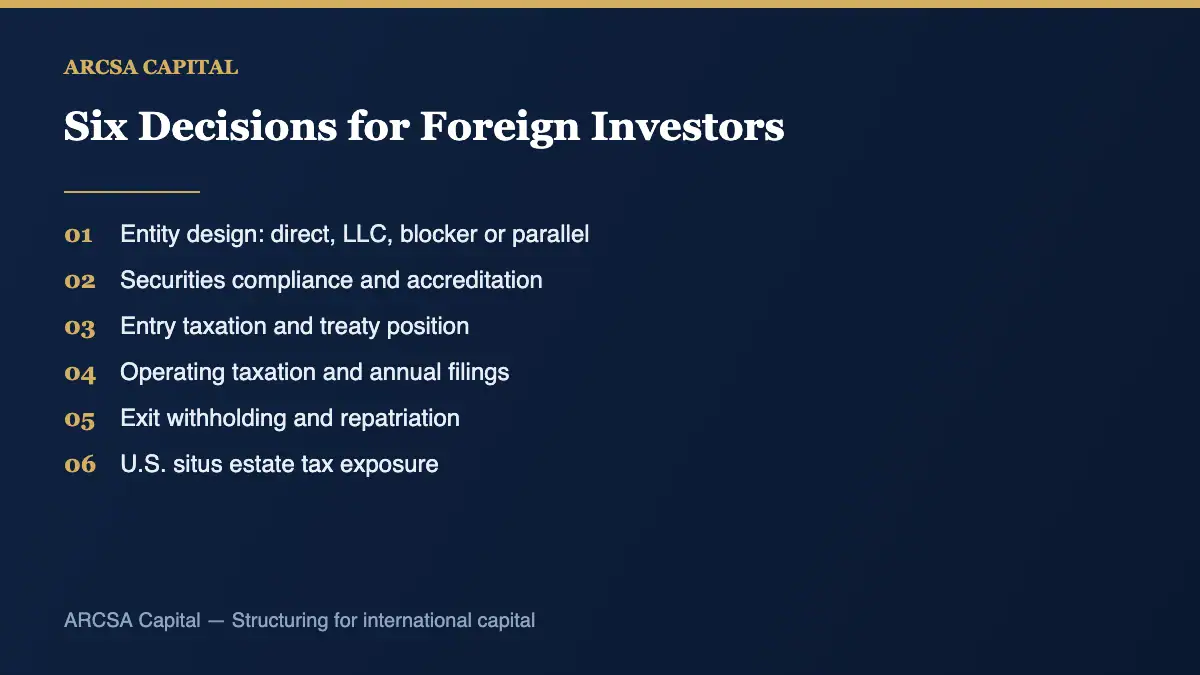
Foreign Real Estate Investors: 6 Points at a Glance
The legal position of foreign real estate investors in the United States is settled before the first property is identified. Six decisions determine liability, tax treatment and filing obligations for the life of the investment.
- Entity design. Direct ownership, LLC, blocker or offshore parallel vehicle, each with a different liability and filing profile.
- Securities compliance. Accreditation verification, offering exemption and subscription documentation.
- Entry taxation. Withholding, treaty position and the classification of income at acquisition.
- Operating taxation. Treatment of rental or development income and the associated annual filings.
- Exit taxation. Withholding at disposition and the mechanics of repatriating proceeds.
- Estate exposure. Whether the interest held creates U.S. situs assets for estate tax purposes.
Each decision is inexpensive to make correctly at the outset and expensive to correct afterwards. That asymmetry is the central practical fact for foreign real estate investors.
What Regulators and Public Filings Reveal About Foreign Real Estate Investors
Investment into U.S. real property by non-residents sits inside a specific statutory regime covering withholding, effectively connected income and reporting. The rules apply differently depending on whether the interest is held directly, through a partnership, or through a corporate blocker.
Securities law adds a parallel set of obligations. Private funds are offered under exemptions that require the sponsor to verify accreditation and to document the offering, and foreign real estate investors should confirm that this documentation exists rather than assuming it.
Guidance published by the Internal Revenue Service on withholding and reporting for non-resident persons is the primary reference here, and it should be read together with advice from counsel in the investor’s own jurisdiction rather than in place of it.
Common Mistakes Investors Make With Foreign Real Estate Investors
The same avoidable errors recur across jurisdictions and investor profiles.
- Selecting the entity after the property is identified, when the closing timetable no longer allows proper structuring.
- Holding U.S. situs assets directly and creating estate tax exposure that a blocker would have avoided.
- Assuming a treaty benefit applies without confirming the limitation-on-benefits conditions.
- Overlooking annual filing obligations that continue whether or not the asset distributes income.
- Applying one structure to a family group whose members hold several different tax residences.
Each is preventable at the design stage. For foreign real estate investors, structuring cost at the outset is consistently smaller than the leakage it prevents at exit.
How to Evaluate Foreign Real Estate Investors in 30 Days
Week One: Establish the Profile
Document residence, entity type, family members involved and expected holding period. Every subsequent decision follows from this profile.
Week Two: Model the Alternatives
Compare after-tax outcomes across direct ownership, blocker and parallel fund, including withholding and repatriation cost.
Week Three: Validate at Home
Confirm the preferred structure with counsel in the investor’s own jurisdiction; a vehicle efficient in the U.S. can be penalised domestically.
Week Four: Document and Subscribe
Complete accreditation verification, review the subscription package and confirm the entities formed match those described in the memorandum.

Frequently Asked Questions About Foreign Real Estate Investors
Can a non-resident own U.S. property directly?
Yes, but direct ownership creates personal filing obligations and potential estate tax exposure. Most foreign real estate investors use an intermediate entity precisely to avoid both.
What is a blocker and when is it used?
A blocker is a U.S. corporation interposed between the investor and the fund. It converts flow-through income into corporate income, removing the investor’s direct filing obligation, and is common where the investor wants no personal U.S. tax presence.
When should structuring be decided?
Before subscription. Restructuring after assets are acquired usually triggers a taxable event, so for foreign real estate investors the initial decision is effectively permanent.
Key Takeaways on Foreign Real Estate Investors
- Structure precedes property; the legal profile is set before any asset is chosen.
- Entry, operating and exit taxation are three separate questions and must each be answered.
- Estate exposure is the most frequently overlooked risk in direct ownership.
- Documentation and accreditation verification protect the investor as much as the sponsor.
Treated as a design exercise rather than a closing formality, the legal framework becomes an asset in itself. Foreign real estate investors who settle these six questions before subscription retain more of the return the underlying strategy produces, and face fewer surprises at the moment of exit.
Ongoing Obligations for Foreign Real Estate Investors
Compliance is continuous rather than transactional. Foreign real estate investors typically carry annual filing obligations for as long as the interest is held, and those obligations persist even in years when no distribution is received. Treating compliance as a closing event is the most common source of avoidable penalties.
The fund’s reporting calendar determines whether those obligations can be met on time. Foreign real estate investors should confirm, before subscribing, which statements they will receive, in what format, and by what date, because many home jurisdictions have filing deadlines earlier than the typical U.S. fund reporting cycle.
Currency and banking arrangements form the third continuing item. Capital calls and distributions may move through several jurisdictions, and the point at which conversion occurs changes the realised return. Well-structured programmes state the conversion and remittance policy in the fund documents rather than leaving it to administrative practice.
Family and Succession Planning Considerations
For many international families the investment decision and the succession decision are the same decision. Foreign real estate investors who hold U.S. situs assets directly can create an estate tax exposure that materially exceeds the return on the underlying investment, and the remedy after death is limited.
- Identify every family member who will hold an interest, and their tax residence.
- Determine whether any of them are U.S. persons, which changes the structure entirely.
- Establish whether the interest should be held by an individual, a company or a trust.
- Confirm how the interest transfers on death and what tax arises in both jurisdictions.
These four questions belong in the structuring review, not in a separate estate planning exercise conducted years later. Foreign real estate investors who address them at subscription usually find that the same structure solves both the tax and the succession problem at once.
Request a Structuring Review for Foreign Real Estate Investors
We map residence, family profile and exit expectation to the vehicle that preserves the most after-tax return.
Request InformationOr model your own scenario in the investment simulator
Or receive the ARCSA Capital investment thesis by email, with the entry, stabilisation and exit assumptions behind the strategy:
